
How to Become a Better Leader: 10 Habits That Actually Work
Most people who want to know how to become a better leader are already doing something right. They are asking the question. That desire to grow is the starting point for every great leader I have ever coached. But desire alone does not produce results. What actually moves the needle is consistent, deliberate habit.
Over more than 15 years working in corporate learning and development, and as a Certified Professional Coach and ICF Associate Certified Coach, I have watched talented professionals plateau not because they lacked intelligence or drive, but because they kept doing the same things and expected different outcomes. The good news? Leadership is a learnable skill. It is not a personality trait reserved for a select few. It is a practice.
This article breaks down 10 proven habits that actually work. These habits are grounded in real leadership coaching, not motivational clichés. If you implement even half of these consistently, you will notice a measurable shift in how your team responds to you, how you handle pressure, and how much confidence you carry into every room.
For leaders who want more personalized support, leadership growth does not have to happen alone. Through leadership coaching services, you can work through your specific challenges, strengthen your leadership habits, and build a clearer path toward the kind of impact you want to have.
What Does It Really Mean to Be a Better Leader?
Before diving into specific habits, it is worth clarifying what "better" actually means in the context of leadership. A better leader is not just someone who hits more targets or commands more authority. A better leader creates an environment where people genuinely want to show up, contribute, and grow.
Research from Gallup consistently shows that the quality of a direct manager accounts for at least 70% of the variance in team engagement scores. That means your habits, including how you communicate, make decisions, handle feedback, and model behavior, directly shape how your people perform. Leadership development is not just a career investment. It is a team investment.
This is also why leadership conversations matter at the organizational level. If your team or company is looking for a practical, engaging way to explore leadership, communication, and generational dynamics, you can book me to speak for a workshop, keynote, or facilitated session.
The 10 habits below address leadership from both the inside out, including your mindset, self-awareness, and energy, and the outside in, including your communication, accountability, and team culture. That dual focus is exactly what separates good leaders from truly impactful ones.
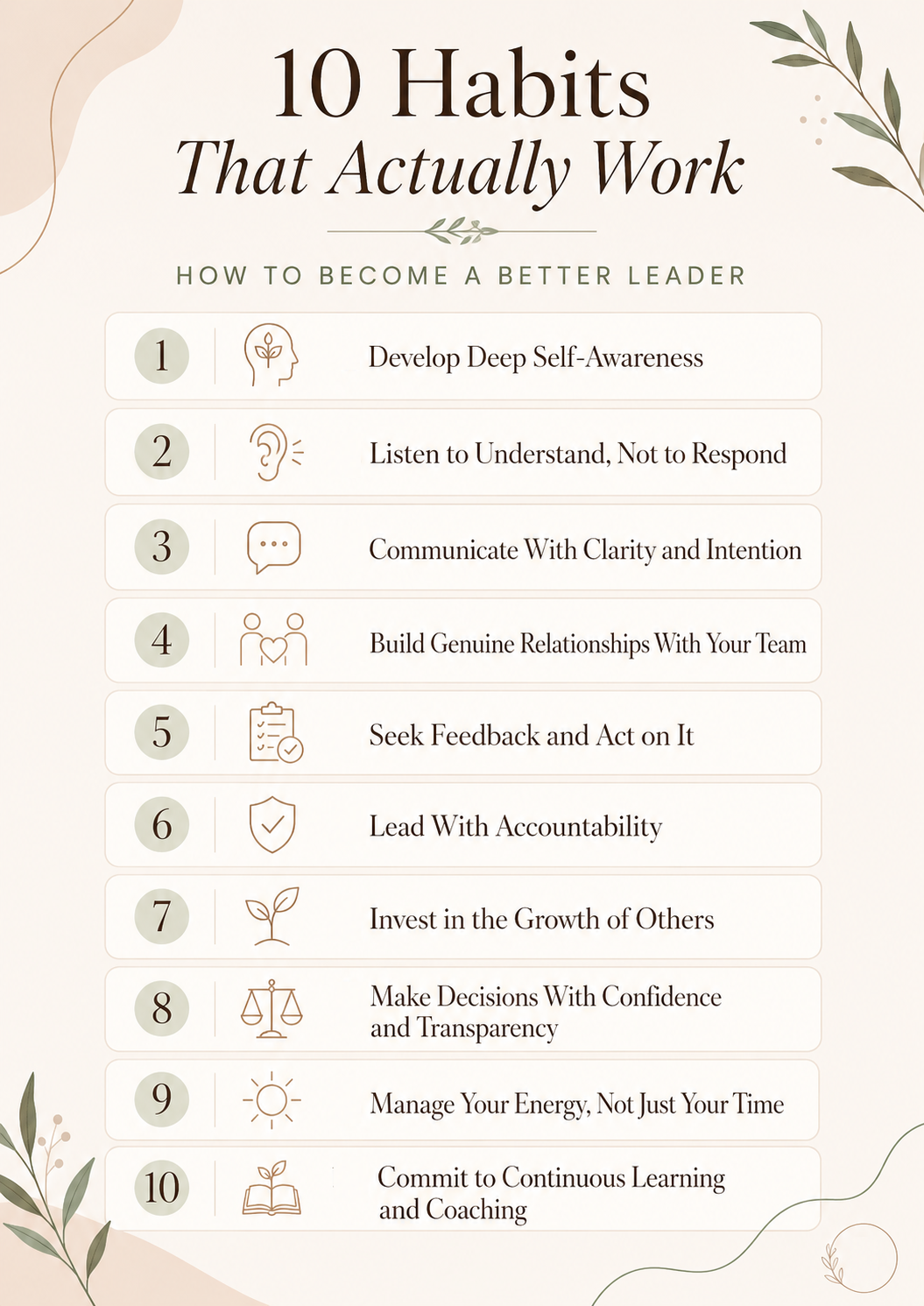
Habit 1: Develop Deep Self-Awareness Before Anything Else
You cannot lead others well if you do not understand yourself first. Self-awareness is the bedrock of every other leadership skill on this list. It means knowing your default reactions under stress, recognizing the blind spots in your communication style, and understanding how your energy, whether positive or negative, lands on the people around you.
In my coaching practice, I use the Energy Leadership Index (ELI) assessment to help clients see their leadership from a new angle. The ELI measures the energetic profile you bring to everyday situations compared with how you show up under stress. Most people are shocked by the gap between the two. That gap is your growth edge.
Practical starting point: At the end of each workday, take three minutes to reflect on one interaction that went well and one that felt off. Ask yourself: What was I thinking going into that conversation? What assumptions did I bring? Over time, these micro-reflections build genuine self-knowledge.
Habit 2: Listen to Understand, Not to Respond
The most common leadership complaint I hear from teams is not "my manager is mean." It is "my manager does not listen." Active listening is one of the most underrated leadership skills in the modern workplace, especially as more leaders manage multi-generational teams where communication styles vary widely.
Real listening means putting your phone down, making eye contact, and resisting the urge to formulate your reply before the other person finishes talking. It means asking clarifying questions instead of assuming. It means sitting with a moment of silence rather than rushing to fill it.
Leaders who listen well earn trust faster, catch problems earlier, and build teams that feel psychologically safe enough to bring their best ideas forward. That is a competitive advantage no strategy deck can buy.
Habit 3: Communicate With Clarity and Intention
Unclear communication is one of the biggest killers of team performance. When people do not know what is expected of them, they default to playing it safe. Playing it safe rarely produces exceptional outcomes.
Better leaders communicate with intention at every level: in one-on-ones, in team meetings, in written messages, and in the nonverbal cues they project. This does not mean being formal or rigid. It means being honest about priorities, transparent about challenges, and specific about what success looks like.
This is also part of building a clear leadership identity. If you want to go deeper on how you are perceived as a leader, you may also find this guide on how to design your professional leadership brand helpful.
One simple but powerful habit: Before every important conversation or meeting, ask yourself what outcome you want from the interaction. That single question sharpens your message and prevents the rambling, inconclusive discussions that drain time and motivation.
Habit 4: Build Genuine Relationships With Your Team
Leadership is not a title. It is a relationship. And like any relationship, it requires investment.
People do their best work for leaders they trust, respect, and feel genuinely cared for by. That does not mean becoming your team's best friend. It means showing up as a consistent, authentic presence. It means being someone who remembers the personal things people share, follows through on commitments, and treats every team member as a whole person, not just a role.
I work with a lot of leaders managing Millennial and Gen-Z professionals, and one thing that consistently stands out in that demographic is the premium they place on authenticity. They can spot performative leadership from a mile away. Real connection, even brief, genuine check-ins, matters more than any motivational speech.
Habit 5: Seek Feedback and Actually Act on It
Most leaders say they are open to feedback. Far fewer actually create structured opportunities to receive it. Even fewer visibly act on what they hear.
When you actively seek feedback from your team, peers, and manager, you send a powerful signal: that you are serious about growing, that their perspective matters, and that leadership is not a one-way street. It also gives you real data on how your behavior lands in practice. No amount of self-reflection can fully replace that.
The key step most leaders skip is closing the loop. When someone gives you feedback, come back to them in two weeks and say, "I heard what you said about X. Here is what I tried differently." That follow-through builds credibility and encourages more honest input in the future.
Habit 6: Lead With Accountability, Starting With Yourself
Accountability is one of those leadership words that gets overused and under-practiced. Teams need to see their leader hold themselves to the same standard they hold others. Nothing erodes team culture faster than a leader who demands results from others while excusing their own lapses.
When you make a mistake, and you will, own it clearly and quickly. No hedging, no blame-shifting, no long-winded explanations. A simple acknowledgment of what happened, what you will do differently, and how you will repair any impact is more powerful than any motivational speech you could give.
Personal accountability also extends to your development goals. If you commit to improving a specific leadership skill, track it, talk about it, and revisit it with someone who will hold you honest, such as a coach, a mentor, or a trusted peer.
Habit 7: Invest in the Growth of Others
The leaders who leave the deepest impact are the ones who made the people around them better. If your team is not growing under your leadership, something needs to change.
Investing in others does not require a formal development budget. It starts with regular career conversations. These are not just performance reviews, but genuine dialogues about where each person wants to go and how you can help them get there. It looks like delegating stretch assignments instead of keeping the interesting work for yourself. It sounds like specific, timely praise that names exactly what someone did well and why it mattered.
People stay in jobs longer and work harder for leaders who invest in their growth. If you want to know how to become a better leader in a tangible, results-visible way, make someone on your team noticeably better this quarter. That is your proof of concept.
Habit 8: Make Decisions With Confidence and Transparency
Indecision is expensive. It costs time, erodes trust, and signals to your team that you are not in control. Strong leaders make timely decisions with the best information available, then communicate the reasoning behind those decisions clearly.
You do not need perfect data to make a good decision. You need a clear framework. What are the goals? What are the constraints? Who will be affected and how? What are you willing to be wrong about? Leaders who can answer those questions quickly and honestly consistently outperform those who wait for certainty that never arrives.
Transparency about your decision-making process is equally important. When people understand why a call was made, even if they disagree with it, they are far more likely to support the execution. Opacity breeds rumors and resentment. Transparency builds alignment.
Habit 9: Manage Your Energy, Not Just Your Time
Time management is taught in almost every leadership program. Energy management is taught in far fewer programs, and it might be more important.
As a leader, your emotional state is contagious. When you walk into a room drained, distracted, or frustrated, your team feels it. When you walk in grounded, focused, and present, that energy shifts the room. This is not a soft concept. It is neurological. Mirror neurons are real, and your team's emotional baseline is influenced by yours more than you may realize.
Protecting your energy means building recovery into your schedule, not treating sleep and movement as optional. It means knowing your personal triggers and having a plan for when they are activated. It means paying attention to the emotional quality of the energy you bring to your most critical leadership moments, not just how many hours you logged.
Habit 10: Commit to Continuous Learning and Coaching
The best athletes in the world have coaches. So do the best executives. The idea that you only need a coach when something is broken is one of the most limiting beliefs in professional development.
Committing to your own development through leadership coaching, mentorship, targeted reading, or formalized training sends a signal to your team that growth is valued here. You model the culture you want to build. A leader who is always learning creates an environment where learning is the norm, not the exception.
Leadership coaching, in particular, accelerates this process in ways that self-study alone rarely can. A skilled coach holds up a mirror, helps you identify patterns you cannot see from inside them, and keeps you accountable to the goals you care most about. The ROI of executive and leadership coaching is well-documented, but more importantly, it simply works.
If you are curious about what that support can actually look like in practice, I break it down further in this article on the real benefits of leadership coaching.
What Gets in the Way: Common Mistakes Leaders Make
Even the most motivated leaders can stall out when they hit one of these common patterns. Recognizing them is the first step to moving past them.
Waiting until they feel "ready" to step into leadership behaviors. Readiness is built through action, not preparation.
Confusing busyness with effectiveness. Filling the calendar is not the same as leading strategically.
Avoiding difficult conversations until small issues become major ones.
Trying to be liked rather than trusted. These are not the same thing.
Leading the same way for every person on the team, regardless of individual needs and motivations.
How Long Does It Take to Become a Better Leader?
There is no universal timeline. Some shifts happen quickly, within a few weeks of consistent new behavior. Others, particularly around deep-seated communication patterns or stress responses, take months of intentional work. What matters most is not the speed of the change but the consistency of the practice.
What leadership coaching research does tell us is that leaders who work with a professional coach develop faster, sustain their gains longer, and report higher levels of confidence and impact than those who try to develop on their own. Having a thinking partner who knows how to accelerate your growth is not a luxury. It is a strategic advantage.
For a broader look at why coaching matters in both personal and professional development, you can listen to my podcast about the importance of coaching.
Ready to Invest in Your Leadership Development?
At Calle Foster Coaching & Consulting, we work with leaders who are serious about growing, not just in title or compensation, but in genuine impact. Our coaching approach blends strategic career development with deeper personal leadership work, because what is happening on the inside always shows up in the results on the outside.
We specialize in working with Millennial and Gen-Z professionals, as well as leaders who manage those generations. Our work helps you close the gap between the leader you are today and the one your team needs you to be.
If you are ready to take the next step, visit callefoster.com to learn more about our 1-on-1 coaching programs and group sessions. You can also reach out directly through the contact page. There is no pitch, just a conversation about where you are and where you want to go.
Frequently Asked Questions About Becoming a Better Leader
Can anyone learn how to become a better leader?
Yes. Leadership is a set of learnable skills, not an innate trait. Some people start with natural tendencies that help, such as high empathy, strong communication, or easy confidence, but every core leadership competency can be developed with the right focus and support.
What is the fastest way to improve leadership skills?
Working with a leadership coach is consistently one of the fastest paths to development because it is personalized, structured, and accountable. Beyond coaching, the combination of seeking real-time feedback from your team and reflecting deliberately on your own behavior accelerates growth significantly.
How is leadership coaching different from leadership training?
Leadership training typically delivers content, including frameworks, models, and concepts, in a group setting. Leadership coaching is personalized to you: your goals, your specific challenges, and your individual growth edge. Training gives you information. Coaching helps you change behavior. Both have value, but coaching tends to produce more durable, individualized results.
What does a leadership coach actually do?
A leadership coach serves as a thinking partner, a mirror, and an accountability structure. In sessions, you work through real challenges you are facing, explore patterns that may be limiting you, and build concrete plans for new behavior. A good coach does not tell you what to do. They help you access the clarity and courage to figure it out yourself, faster than you would on your own.
The Bottom Line
Knowing how to become a better leader starts with honesty: about where you are, what is working, and what needs to change. The 10 habits outlined here are not a checklist to power through in a week. They are a framework to return to consistently, build on gradually, and measure over time.
The leaders who improve most are not necessarily the most talented ones. They are the most intentional. They pay attention. They ask better questions. They do not wait for a crisis to prompt their growth. They treat leadership as a practice, and they show up for that practice regularly.
You already have the desire to grow. That counts for a lot. Now pair it with a plan.