
7 Real Benefits of Leadership Coaching (That Nobody Tells You Before You Start)
There's a moment most managers hit where raw talent and a solid work ethic stop being enough. The skills that got you promoted, your technical chops, your ability to execute, your individual performance, are genuinely not the same skills that make you an effective leader of people. That gap is real, it's uncomfortable, and it's exactly where the benefits of leadership coaching start to show up.
Leadership coaching isn't a remediation tool or a sign that something is wrong with you. It's a strategic investment in how you lead, communicate, and grow, both professionally and as a person. For managers navigating multi-generational teams, early-career leaders figuring out who they are in their role, and executives making high-stakes calls every day, the benefits of leadership coaching are measurable, lasting, and often the thing people wish they'd started sooner.
Here are seven of those benefits so you can see what this process delivers and decide if it's the right move for where you are right now.
What Is Leadership Coaching?
Before we get into the benefits, let's be clear on what leadership coaching actually is, because there's a lot of confusion out there.
Leadership coaching is a structured, one-on-one development process where a trained coach works with a leader to identify blind spots, sharpen specific skills, and align personal values with professional goals. It's not consulting (a coach doesn't hand you a list of answers). It's not therapy (it's forward-looking and performance-focused). And it's definitely not the generic leadership seminar where you sit in a conference room for a day and walk out with a workbook you'll never open again.
At Calle Foster Coaching, leadership coaching is a deeply personalized experience built around the specific challenges today's managers face, including leading Millennial and Gen Z talent, building a strong leadership identity, and developing the confidence to lead with both strategy and authenticity.
7 Benefits of Leadership Coaching for Managers and Executives
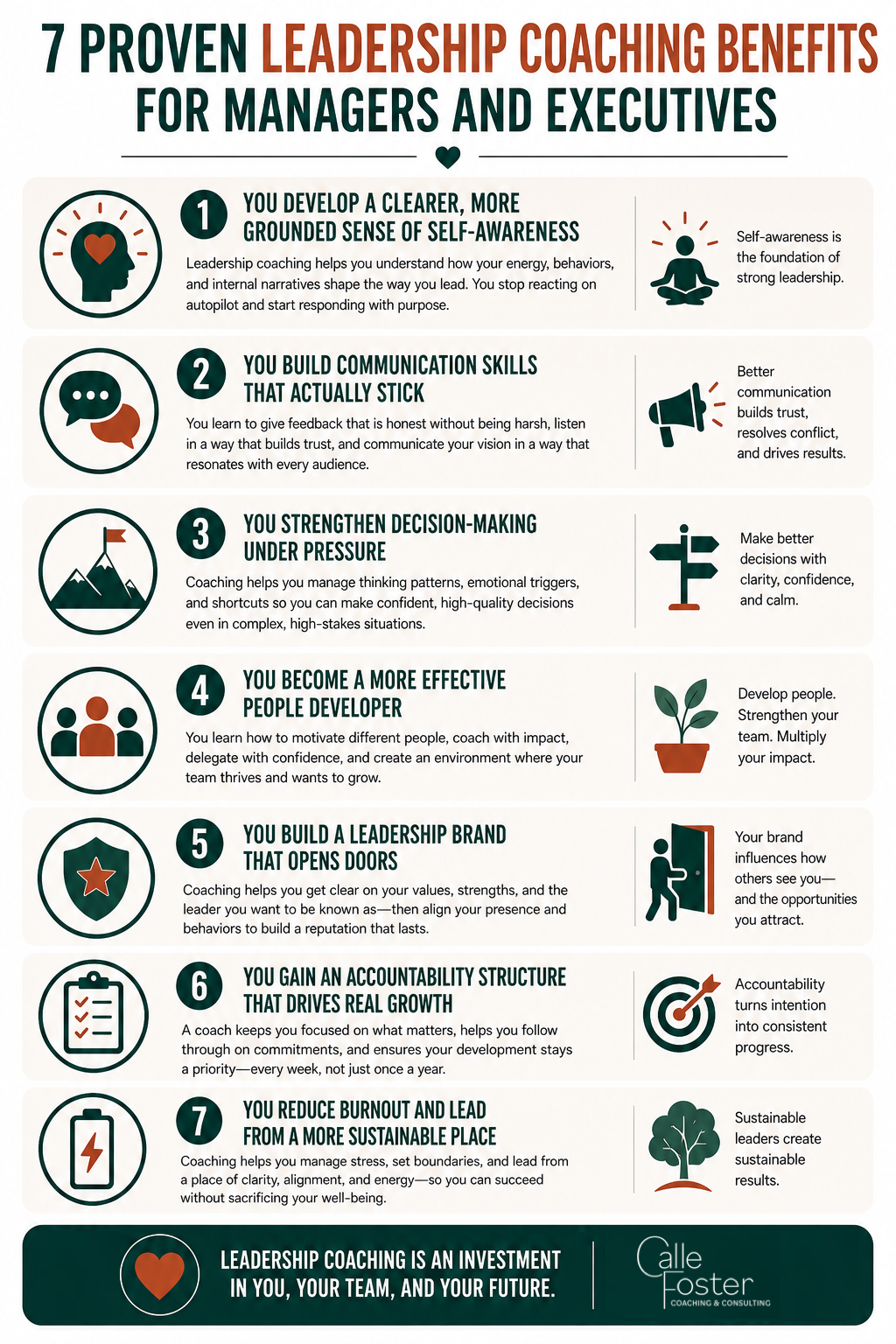
1. You develop a clearer, more honest sense of self-awareness.
Self-awareness is the foundation of strong leadership. Without it, you can't see how your communication style lands with your team, how your stress responses affect the people around you, or where your strengths end and your blind spots begin.
One of the most consistent benefits of leadership coaching is the development of real self-awareness, not the surface-level kind you get from a personality quiz, but the kind that comes from working with a skilled coach who asks the questions that make you actually stop and think.
When you understand how your energy, your internal narratives, and your default behaviors shape the way you lead, you stop reacting on autopilot and start responding with intention. This is central to the work at CFC. Using the Energy Leadership Index (ELI), a research-backed attitudinal assessment rated by Forbes in the top three assessments every executive should take, we identify the energy patterns driving your thoughts and stress responses, and then build the awareness to shift them when it counts.
2. You build communication skills that actually transfer to real situations.
Poor communication is at the root of most leadership problems. Teams lose trust in leaders who are unclear, inconsistent, or unable to adjust their message for different audiences. Projects stall. Conflict goes unaddressed. Talented people start looking for a way out.
Leadership coaching builds communication skills at a behavioral level, applied directly to the challenges you're navigating right now at work, not in a vacuum. You learn how to give feedback that's direct without being harsh, how to listen in a way that makes people feel genuinely heard, and how to communicate your expectations in language that resonates across different generations and work styles.
For managers leading Millennial and Gen Z teams specifically, this is a skill set that traditional training programs rarely address with the depth it deserves. It's also one of the most requested areas of growth among the leaders I work with.
3. You make better decisions under pressure.
Managers and executives make dozens of decisions every day, and the cost of poor decisions compounds quickly at that level. Most leadership development programs teach strategy in a vacuum, away from the actual pressure, ambiguity, and complexity where decisions actually happen.
One of the most valuable benefits of leadership coaching is improved decision-making in real-world conditions. A leadership coach works with you on the thinking patterns, emotional triggers, and mental shortcuts that shape how you make choices, especially under stress. You learn to slow down in moments that demand speed, to seek input without losing authority, and to trust your own judgment in the gray areas where there's no clearly right answer. Over time, that produces a kind of confidence that's hard to manufacture any other way.
4. You become the kind of leader who actually develops other people.
Strong leaders don't just get results. They grow other people. The ability to develop talent, delegate effectively, and build a team that performs well without you hovering is one of the most in-demand leadership skills in any organization, and one of the least naturally developed.
Leadership coaching sharpens this significantly. You develop a more nuanced understanding of what actually motivates different people, how to coach rather than manage, and how to create an environment where your team wants to show up and perform. When you become stronger at developing people, your team's performance improves, your organization retains its best talent, and your own value as a leader increases in ways that show up in the results you're measured on.
For managers working with early-career professionals, which is a core focus of my work, this is especially important. The Millennial and Gen Z workforce has specific expectations around growth, feedback, and purpose. Learning to meet those expectations isn't just good management; it's a competitive advantage.
5. You build a leadership brand that actually opens doors.
Your leadership brand is the reputation you carry, meaning the way people describe you when you're not in the room. It's shaped by how you communicate, how you handle adversity, how you treat people at every level of an organization, and how clearly others can articulate what you stand for.
Most managers never build their leadership brand intentionally. They let it form by default, shaped by whatever impressions they happen to leave. Leadership coaching changes that. You get clear on your values, your strengths, and the kind of leader you want to be known as, and then you develop the behaviors that make that brand visible and consistent.
A strong leadership brand isn't self-promotion. It's earning a reputation that reflects your actual skills and character, and it's what gets you considered for high-stakes opportunities, sought out for mentorship, and respected by the people you lead. Building a compelling leadership brand is one of my signature areas of expertise, and one of the areas where I see the most tangible momentum for clients quickly.
6. You gain an accountability structure that makes growth actually happen.
This might be the most underrated benefit of leadership coaching: accountability. Most leaders have plenty of ambition and good intentions. What they lack is a structured, consistent process for following through on their development goals.
The demands of a leadership role are relentless. Without something holding you to your commitments, personal growth gets pushed to the bottom of the priority list indefinitely, every quarter, every year. A leadership coach creates the accountability structure that keeps it on the agenda. Every session, you review what you committed to, what you followed through on, and what got in the way. Your goals stay visible and progress is tracked, so the work of becoming a better leader doesn't only happen during annual review season.
This isn't about someone checking up on you. It's about having a dedicated partnership where your growth is the entire point of every conversation.
7. You reduce burnout and build a more sustainable way of leading.
Leadership burnout isn't a character flaw. It's what happens when high-performing people carry more than any one person should carry, without the right support in place. Left unchecked, it erodes your judgment, damages your relationships, and quietly dismantles the career you've worked hard to build.
One of the most important benefits of leadership coaching is that it addresses burnout at the root rather than treating the symptoms. You identify the internal and external pressures draining your energy, build boundaries that protect your capacity, and develop the kind of leadership mindset that holds up over years, not just through a particularly intense quarter.
This one is personal for me. I've spoken openly about the cost of chronic stress in my own corporate career, and that experience directly shapes how I approach this work. Leading sustainably isn't just about managing your calendar better. It's about leading from a place of genuine energy and alignment, and that's something we build together over the course of a coaching engagement.
Who Gets the Most Out of Leadership Coaching?
Leadership coaching delivers results across a wide range of roles and experience levels, and certain moments make the investment especially well-timed:
New and aspiring managers who are navigating the shift from individual contributor to people leader and need to build their leadership identity fast. Mid-level managers who are strong performers but feel overlooked, plateaued, or unclear on how to get to the next level. Senior leaders and executives dealing with complex decisions, organizational dynamics, or the kind of isolation that comes with authority. Leaders managing diverse, multi-generational teams who want to get more out of their people and build stronger team cultures. Professionals rebuilding their leadership identity after a major transition, setback, or career shift.
How to Actually Get Results From Leadership Coaching
The leaders who benefit most aren't necessarily the ones with the biggest problems. They're the ones who show up with honesty and a real willingness to do the work.
That means being truthful about the patterns you want to change, staying consistent between sessions, and applying what you're learning in the actual moments that matter: the hard conversation you've been avoiding, the high-pressure decision, the feedback you've been putting off for weeks.
Leadership coaching isn't passive. The results are directly tied to the level of engagement you bring to the process.
Are the Benefits of Leadership Coaching Worth the Investment?
The research says yes. The International Coaching Federation consistently reports that professionals who engage in coaching see improvements in communication, goal attainment, team performance, and overall job satisfaction. But the most compelling evidence tends to be specific: the manager who finally stopped avoiding conflict and built a team that trusts her. The executive who reclaimed her focus after years of grinding through burnout. The emerging leader who stopped waiting to feel ready and started leading with conviction.
The benefits of leadership coaching listed here aren't theoretical. They're the kinds of shifts that happen inside real coaching relationships, built on real trust, with a coach who understands what it takes to lead well in today's workplace.
If you're ready to build those skills, I'd love to connect. My 1:1 coaching programs are designed specifically for Millennial and Gen Z leaders who want to grow with purpose, with strategy, and with the kind of support that moves the needle. Learn more or book a discovery call at callefoster.com.